From half a tonne to several tens of tonnes — one commercial contract, one quality record, and a process route written around the crane, the furnace and the machining envelope rather than around a catalogue number.
Large castings are not simply bigger versions of component castings. The constraint is the whole chain: pattern and moulding cost, pit and crane capacity, heat treatment furnace dimensions, machining envelope, and how the finished part travels from the foundry to your site. A part that can be poured but cannot be heat treated, machined or shipped is not a deliverable.
We do not run a pit furnace of our own. What we run is the route: we qualify the heavy foundries, write the process plan, sit in the witness tests, coordinate heat treatment and machining, and take responsibility for the part arriving to drawing. That is the commercial value in this line — engineering accountability rather than crane tonnage.
This line covers single heavy pieces. For series parts from 0.05 kg to a few hundred kilos, switch to Component Castings →
Ranges are typical for the qualified partner foundries in this line. The working limit for your part is confirmed at drawing review, together with the transport route.
| Process | Typical single weight | Maximum envelope | Notes |
|---|---|---|---|
| Resin bonded sand | 0.5 – 20 t | 2,000 × 1,500 mm standard; non-standard to 4,000 × 3,000 mm | box and partner dependent |
| Pit moulding | 10 – 45 t | pit approx. 20 × 7.5 × 4.5 m | crane and pit dependent |
| V-process (vacuum) | 1 – 12 t | up to approx. 3,800 × 2,350 mm | thin-wall large parts |
| Lost foam | 0.1 – 5 t | up to approx. 1,000 × 800 × 600 mm | pattern per piece |
| 3D printed sand | 0.2 – 5 t (cores and small moulds) | printer-bed dependent | complex internal geometry |
| Heavy ductile iron | 5 – 40 t | up to approx. 3,500 × 2,500 mm | wind hub and base frame parts; thick-section nodularity control |
| Cast steel | 0.5 – 45 t | up to approx. 1,800 × 1,400 × 1,000 mm | normalising / Q&T coordinated |
Heavy machine tool beds, columns and press frames with guide surfaces, requiring stress relief before finish machining.
Hub, base and bearing housings in heavy ductile iron, with thick-section nodularity and UT coverage.
Crusher frames, spider caps, mill heads and trunnions in cast steel or high-chrome wear grades.
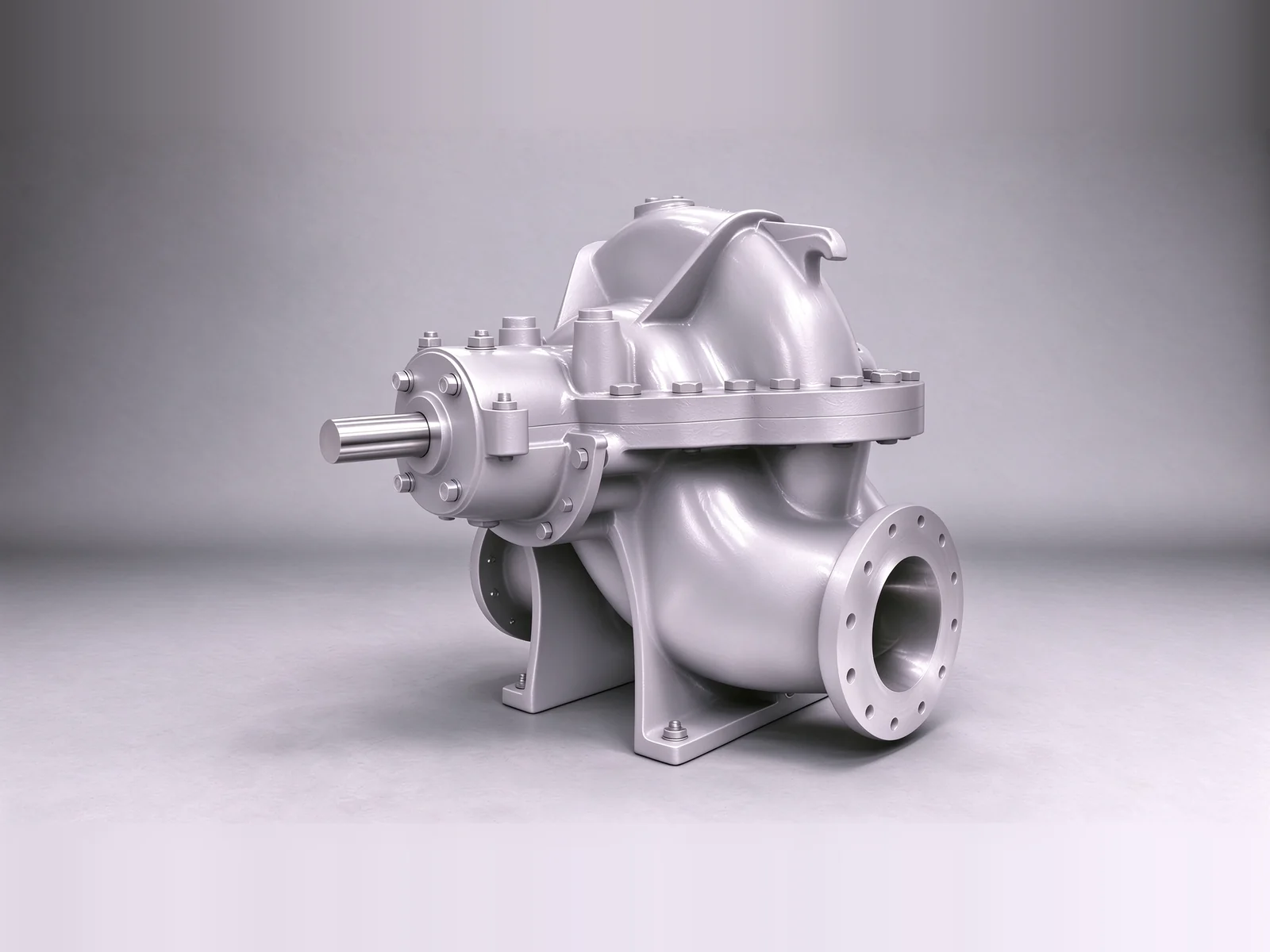
Large pump casings, valve bodies and housings for water, power and process plants.
Heavy split housings with large bearing bores, machined and checked for alignment.
Cast iron counterweights and ballast blocks produced to a defined mass and envelope.
Heavy parts are expensive to scrap, so the checks are planned as hold points rather than as a final inspection.
Feeding, chilling and solidification reviewed before tooling, so thick sections are planned rather than discovered.
Your inspector or a TPI such as SGS / BV can attend pouring, testing and final inspection; we arrange access and records.
UT on heavy sections, MT and PT on machined and loaded faces, RT where the specification calls for it.
Tensile, impact and hardness per heat, with microstructure checks on ductile iron and heat-treated steel.
Large-part dimensional reports, and pre-assembly checks where mating parts are supplied together.
Material certificates, heat treatment records, NDT reports and dimensional reports issued as one pack per order.
Anonymised descriptions. Weights and operations are representative; customer names, drawings and end-user details are omitted by agreement.
Bed casting around 12.5 t, stress relieved before finish machining of guide surfaces, flatness reported on a granite reference.
Frame around 9 t normalised after shakeout, UT on the loaded sections, bores machined to the mating assembly.
Casing around 4.2 t with heavy flanges, machined sealing faces and hydrostatic test before painting.
Series production from 0.05 kg to about 500 kg across all seven processes, with machining, first-article documentation and price breaks that work at your volume.
View the component lineSend the drawing and the delivery constraints; we will come back with a route, a foundry and a transport plan.